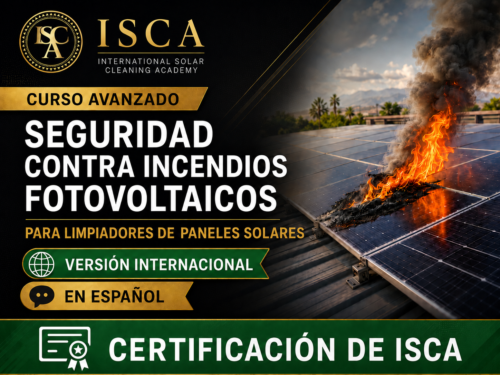
PV Fire Safety (PVFS) – Fire Risk Doesn’t End When Installation Is Complete.
Every year, photovoltaic systems become older, larger and more complex.
As systems age, electrical faults, connector failures, damaged cabling, bird contamination and maintenance activities all contribute to an increasing fire risk.
ISCA developed the PV Fire Safety (PVFS) Certification Programme to help solar cleaning professionals, O&M contractors and site managers understand these risks before they become incidents.
This course is built around real fire investigations, international guidance, firefighter experience and documented industry incidents—not theoretical classroom examples.
Why ISCA Created This Programme
This didn’t exist because we wanted another course.
It exists because we kept seeing the same failures.
Bird nests.
Damaged connectors.
Poor cable routing.
Unsafe cleaning methods.
Incorrect emergency responses.
Firefighters lacking information.
Maintenance contractors unaware of electrical hazards.
Rather than waiting for regulations to catch up, ISCA developed an independent professional certification focused specifically on photovoltaic fire risk.
Why Fire Safety Matters
Fire incidents involving photovoltaic systems continue to increase worldwide.
• Thousands of PV fires have now been documented internationally.
• Electrical failures remain the leading cause.
• Ageing systems represent an increasing percentage.
• Firefighters increasingly require specialist PV guidance.
• Insurers are asking more questions about electrical risk management.
(Sources: International Fire Incident Register, ISCA Research Library, NFPA, national fire authorities.)
Built From Real Incidents
This course includes lessons learned from:
✓ Commercial rooftop fires
✓ Bird-related fires
✓ Connector failures
✓ Arc faults
✓ Thermal events
✓ Rooftop maintenance incidents
✓ Fire service operational reports
We don’t teach hypothetical situations.
We teach documented events.
Who The PVFS Course Is For
This advanced course is designed to be taken after the ISCA Foundation SPCT course. It is ideal for:
-
Professionals responsible for the safe operation, maintenance or cleaning of photovoltaic systems
-
Solar O&M and maintenance teams
-
Business owners who need to prove they take PV fire risk seriously to insurers and clients
-
Health & Safety managers responsible for working-at-height and live electricity tasks
What you’ll be able to do after PVFS
After completing PVFS, you will be able to:
-
Communicate how PV fires start and the real-world causes behind them (not just the theory).
-
Assess common fire risks on rooftops, carports and ground-mount arrays before they turn into incidents.
-
Implement safer working methods around live DC when cleaning and maintaining arrays.
-
Communicate clearly with clients, insurers and fire services about PV fire risk and your control measures.
-
Build PV fire safety into your JHAs, RAMS and method statements so they stand up to scrutiny after an incident.
Risk & Insurance Benefits
Solar arrays don’t just represent a fire risk to buildings – they also put your staff, firefighting crews and the public at risk if they’re not understood properly.
PVFS helps you:
- Perform a root cause analysis on possible solar fires on the properties of your clients
- Meet insurer expectations by proving your competency to work on live electrical equipment
- Avoid civil liability, should a claim against you occur for a PV fire, even months after you have left site
- Prove yourself and your staff to be competent should there be a regulatory investigation for a PV fire on a system that you clean and maintain
-
Reduce the likelihood of fire caused by damage, poor routing, birds, contamination and poor maintenance.
-
Document your PV fire safety controls in a way that insurers and investigators understand.
-
Show clients that you’re not “just a window cleaner on a roof” – you’re trained to work safely around live DC and elevated fire risk.
What You Get
Your PVFS enrollment includes:
-
Two-year ISCA Professional Certification
-
Inclusion within the ISCA certification framework
-
Digital verification
-
Continuing Professional Development recognition
- Eligibility for future advanced programmes
- Peace of mind in the event of a health and safety audit of you or your company
Why Now?
PV fire incidents are increasing as systems age, get dirtier and suffer more physical damage over time. In some leading solar powered countries, firefighters are being called on average, to 1 PV fire every 2 days! If your name is on the invoice, your name is in the frame when something goes wrong. PVFS gives you the knowledge and language to show that you took fire risk seriously before an incident – not after.
ISCA’s guidance has been developed from real incident investigations, international best practice, firefighter experience and thousands of hours working on photovoltaic systems.
FAQs
Q: How quickly do I get my PVFS certificate?
Standard: within 5–7 working days of completing the course. Need it faster? Add the Express Certification Pack and we’ll send your documents within 1 working day.
Q: Who recognises ISCA training?
All ISCA training courses are designed to fulfil training requirements from the major health and safety bodies from around the world, including OSHA, HSE, EU-OSHA & SWA. None endorse specific training companies or courses. The requirement to train always rests with the operative and employee. Amazon, BMW, IKEA, Rolls Royce and many others use companies who have their staff ISCA-certified.
Q: Does PVFS help with insurers and tenders?
Yes. Many clients and insurers now expect evidence that you understand PV fire risk. PVFS gives you a recognised certificate plus wording you can add to your paperwork to show that you’ve trained for PV fire safety specifically, not just generic working at height.
Course Contents
Module 1
Understanding Why PV Fires Occur
Module 2
Lessons From Firefighters
Module 3
Electrical Components Most Likely To Fail
Module 4
Incident Investigation
Module 5
Emergency Communication
Module 6
Working Safely Around Fire Risk
Module 7
PPE and Incident Prevention
Module 8
Case Study Analysis